

For newcomers to Beijing, choosing where to live is a crucial and often daunting decision. Beijing’s neighborhoods vary significantly, and selecting the right one can greatly enhance your experience of the city. This guide offers a breakdown of popular residential areas for expats and key considerations to help you make an informed choice.
Understanding Beijing’s Layout
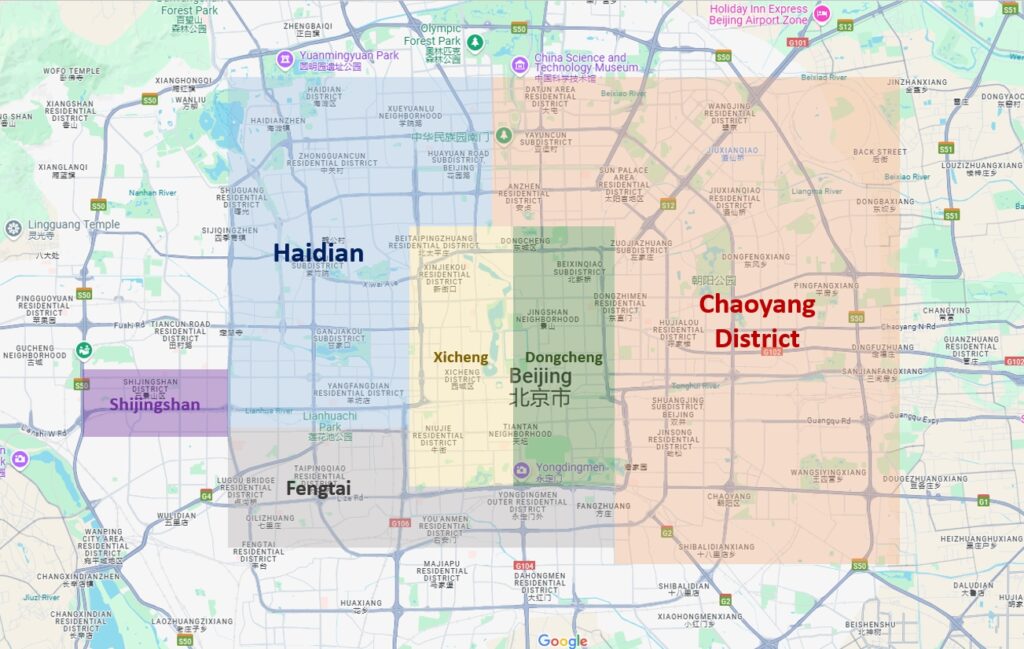
The core urban area of Beijing includes six districts: Dongcheng, Xicheng, Chaoyang, Haidian, Fengtai, and Shijingshan. Among these, the central four—Dongcheng, Xicheng, Chaoyang, and Haidian—are the most relevant for expats. Generally:
- The East (Dongcheng and Chaoyang): Best for expats working in private companies, international organizations, or embassies.
- The West (Xicheng and Haidian): Ideal for those in academia or government roles.
- The North: More appealing than the South, with better facilities and proximity to expat communities.
Beijing’s sprawling size and dense traffic mean that living close to your workplace is essential. Commutes exceeding an hour on public transportation can be grueling.

Top Neighborhoods for Expats (IMHO)
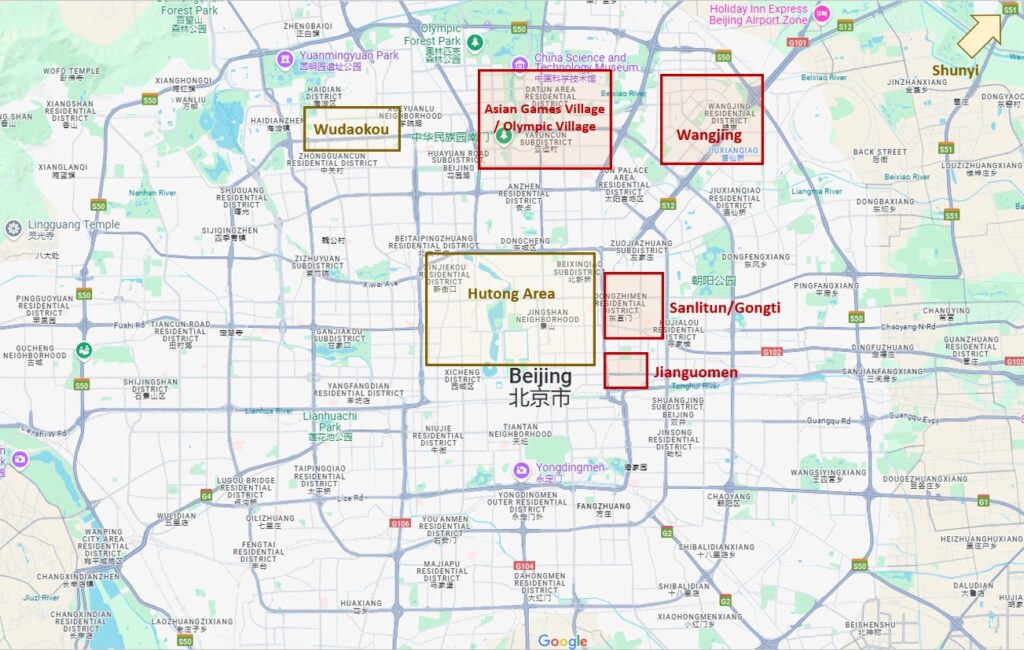
Sanlitun / Gongti (Top Pick)
Overview: The iconic expat hub near the city’s Second Embassy District, Sanlitun extends to the Liangmaqiao area, which houses the Third Embassy District.
Pros:
- Diverse housing options.
- An unparalleled selection of restaurants, from budget-friendly to upscale fine dining.
- Numerous grocery options for imported goods such as Sanyuanli Market.
- Vibrant nightlife and social opportunities.
- Close by cultural landmarks like Beijing Workers’ Stadium.
Cons:
- Higher rental costs.
- Not ideal for those seeking quiet, traditional Beijing charm.
- Occasional reports of drug-related activity in the area, though Beijing’s overall safety remains excellent.
Jianguomen (Worth Considering)
Overview: Centrally located along Chang’an Avenue, close to the First Embassy District.
Pros:
- Proximity to embassies and international companies’ offices.
- Access to Ritan Park, a peaceful oasis in the middle of the city.
- Imported goods are available at grocery stores like Jenny Wang.
Cons:
- Limited high-quality housing options.
- Frequent traffic disruptions due to security protocols in the city center – it is quite annoying when you rush for work or go home.
- Fewer dining options compared to Sanlitun.
Asian Games Village / Olympic Village
Overview: Home to venues from the 2008 Summer Olympics and 2022 Winter Olympics.
Pros:
- Excellent sports facilities: Olympic Forest Park for jogging, Water Cube for swimming, Ice Ribbon for winter sports like skating. These facilities are of top quality.
- Modern and reasonably priced housing.
Cons:
- Further from most expat workplaces, require public transit.
- Fewer expats live in the area compared to Sanlitun.
- Limited international dining options.
Wangjing
Overview: Located northeast of the city, Wangjing is home to a thriving Korean expat community and several multinational companies.
Pros:
- Convenient for those working in local companies.
- Affordable and newer housing options.
Cons:
- Traffic is not challenging when you want to go into central Beijing.
- Fewer dining and imported goods options than in central areas.

Unique Living Options (and why we do not put them in first considerations)
Shunyi District (Suburban Villas):
Located near the airport, Shunyi boasts large villas, international schools, and an affluent expat community. It’s perfect for families seeking suburban comforts or those whose employers provide substantial housing allowances. However, the commute to downtown Beijing can be long and inconvenient for regular commuters.
Hutongs (Traditional Alleys):
For those seeking a quintessential Beijing experience, hutongs in Dongcheng or Xicheng offer unparalleled charm. However, they come with severe challenges: it is difficult to find an ideal hutong house; most houses are not as modern ( modern and private bathrooms tend to usually be the key challenge); and the need to adapt to local neighborhood culture.
However, if you are fortunate (and patient) to find a good place, Hutong is the best choice if you want to feel Beijing in the ground; imagine when you climb up to your own terrace on a clear summer day, you will see hundred-year-old trees right in front of your eyes, a flock of pigeons flying by in the sunset, a nice breeze, and you take a cool drink – you will feel that life is nothing more than that.

Finding the Right Home
If you’re already in Beijing, property trading platforms like Lianjia (Beike) and Maitian are reliable for apartment hunting, with agents who can show you properties in person. For those abroad, expat-oriented real estate agencies may be helpful.
Be careful of leasing contracts:
Rental agreements in China are often in Chinese, and negligence of details can lead to disputes and costs
I once represented a client to defend his rental rights – because when he withdrew from the tenancy, he found that the agent had deliberately miswritten “deposit” as “rent”. and based on this, he was not refunded the deposit. At that time, my client’s Chinese was not good, so he blindly signed the contract, which led to this kind of unpleasantness. After some work, I was able to help him get half of his deposit back through a lawsuit (the judge decided that my client was also liable for negligence). Since lease contracts are almost always in Chinese or “Chinese version shall prevail”, having a friend you trust, or a credible legal service to help you keep an eye on your lease (which doesn’t cost much money) is one of the most worthwhile expenses.